As marketers, we spend a lot of time focusing on the funnel and creating the perfect landing page optimized to convert visitors into leads. I’ve even compiled a list of great resources to help folks get started with their landing pages.
But what about the unsubscribe page? Should you spend time on this page? Well, yes and no.
The unsub page should be clean and simple. It should be as confusing as a traffic light – meaning – not confusing at all.
I highly recommend a simple text statement, box for the email address, and a unsub button. Kind of like this:
The Perfect Unsubscribe Page
There’s just no other way to simplify the unsubscribe process. And in my opinion the goal of your process should be to get unhappy people off your list. This saves you time and money, but also reduces the risk of creating a even more unhappy customer who may start speaking about their displeasure.
Now, if you have a complicated marketing process that involves multiple newsletters, lists and all touch points, you will invariably have to add to this page. But do so cautiously – you don’t want to make it difficult to unsubscribe.
For instance, I have a client that let’s people unsubscribe their email address separately from their phone number. When you hit their unsubscribe page, it looks like the above page. After submitting, it then asks, “would you also like to remove your phone number from our list?” And it walks folks through how to do that.
Perhaps even more importantly, if the email address is cached as a cookie, the unsubscribe page recalls the address for the user so they don’t have to type it. This is particularly helpful if the user has multiple email addresses and is unsure which one they used to sign up on your site.
Still not satisfied? Here’s a great (and humorous) article about unsubscribe pages that I recommend.
The following article is by a colleague of mine, George Fox. George is a guru in all things web design and development and we’ve been working on a number of projects together this past year spanning the web with regards to intake, branding, conversion and usability. You can access George’s blog here for more insight: http://tigerfox.posterous.com.
Adobe Flash
In early August, one of my colleagues forwarded me an article on Read Write Web heralding Adobe’s open beta of Edge: a tool for creating animated web content in HTML, CSS and javascript. At the time I wrote:
I’ve been following Edge for the last year when teaser footage of it showed up on Adobe Labs. I’m sure it will eventually be pretty cool, but any talk of Flash’s death is greatly exaggerated. I have Edge on my (personal) laptop as well as Tumult’s Hype and used to have Sencha Animator. I don’t think there’s any danger of any of these replacing Flash for its breadth of mature programming capability, workflow or file I/O in the next few years. I do think that a vast majority of Flash banners, basic web animation stuff and interactive infographics will be replaced by HTML5/CSS3 alternatives. But deep stuff like games, applications and specialized front-end interfaces will require more than basic web technologies alone can deliver – at least until a competitively-priced robust, easy-to-author framework comes along.
I stand by my assertion that Flash isn’t going away soon. The news about Adobe abandoning Flash Mobile isn’t surprising – as far as I can tell they never got much traction with it anyway. But in line with what I said: as more “banners, basic web animation stuff and interactive infographics” are built in HTML/CSS rather than relying on plug-ins, Flash’s web usage will ebb. It’s not just Flash Mobile that will be affected. This change will affect PC browsing and hasten Flash’s obsolescence. Just browse the comments.
Besides the kneejerk overreactions, there’s so much anger and apprehension. Too bad Adobe can’t simply state that they want to make the best software available rather compromise on shoddy initiatives or all that ambiguous mumbo-jumbo about ‘increasing investment in HTML5’ and ‘delivering compelling web and application experiences.’ Flash may not be dead, but this will be seen as an epic fail.
Now is much like ten years ago when Flash became ubiquitous. The state of the web was shifting from static pages to interactive ones; from CD-ROMS to streaming media. Flash had a decent authoring environment and adapted to the programming challenges well enough, but never could keep up with the shift toward simple standards-based accessible content. Even now, the best it can do is act as a browser or mediator for such content. We don’t need that anymore. What we need are tools that help us take advantage of the advanced capabilities inherent in HTML and CSS. I don’t think it will be one of our current crop of word processors, page layout applications or IDEs. Whoever builds a scalable, efficient, capable authoring tool for HTML5 web applications may rule the next decade.
I’ve written previously that I feel the mobile app world will soon be replaced by mobile-friendly functionality on the web for many reasons. Mobile devices will soon be smart enough to interact with newer websites to provide users with an “app-like” experience, but also data plans and bandwidth will become faster and ubiquitous.
Perhaps an early indicator of this is the Financial Times. The usage of their web site for mobile devices has usurped that of their iPhone app. This makes particular sense because the app would constantly have to download new data (news) to stay relevant… so why not just go straight to the FT website instead?
You can read the story to learn more about this on Reuters:
About Us pages are “the window into the personality of your company/business/org”. As such, you should invest some time and energy into creating a useful, informative and accurate page.
With this in mind, here’s a great post Bryan Eisenberg on top traits of an about us page. He sites some awesome about us pages from a variety of companies. These should inspire you to reexamine your page and identify some short and long term improvements.
Does the speed at which your web pages load really matter, especially in this day and age where broadband is becoming ubiquitous?
YES!
It still matters, and perhaps more than ever as devices uncouple from broadband networks and switch over to mobile networks where loading clunky pages with heavy plug-ins and images can cause exceptionally high bounce rates.
And, page load time heavily influences both PAID and ORGANIC search rates. If you are wondering what the impact is on your sites performance, check out this ClickZ.com article written by Bryan Eisenberg. Bryan states that by adding a second to your page’s load time you could be risking 7% of your traffic.
Worse yet is that some sites take more than just a few seconds to load… they take north of 10 seconds. Image what shaving a few seconds off could do to your user experience and bounce rate?
But where to get started? Landing page optimization is a heavy science and you can spend a lot of time optimizing various parts including:
javaScript
plug-ins
CSS
HTML
Flash
Image compression
Content
All of these factors can be optimized to reduce your pages load time. So, stop wasting time and start optimizing. The easiest place to start is with your images. From there, I would recommend understanding the value you are getting from the social plug-ins. How many people visit your page and how many are “liking” or “+1″ing your page? Is that number of people worth adding an extra half a second to load all those plug-ins? I bet you it isn’t!
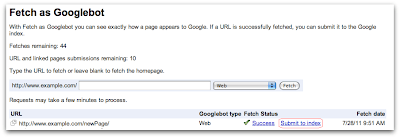
Rob Young at Search Engine Watch reports on a new feature that Google released that speeds up your ability to have Google index your site. This is especially important in two key scenarios:
If you have time sensitive content you needed indexed.
If you need to clear the cached version of your site.
Screen Grab from Google's Webmaster Central Blog Showing the new Indexing Feature
This tool is part of Google Webmaster Tools (GWT). If you are not using the free GWT (including the landing page optimization features), you’re missing out on several opportunities to improve your sites performance.
Should you invest in building out a mobile application for a smartphone, or instead, take your website into the mobile generation and just “mobilize” your website?
One of the main drives I mentioned were corporate budgets.
However, the technology that will make this a reality is HTML5. Here’s a great article which explains what HTML5 can deliver that its predecessors could not, and therefore gave way to the rise of mobile apps:
Here are some of the absolutely best articles I have come across of the years with regards to building and optimizing great landing pages and the calls to action (CTAs) that great pages need.
And, if the above pages weren’t enough to get you going, the resource below is one of the most comprehensive and up-to-date analysis of create the VERY BEST FORMs for all types of situations: Conversion Optimization: An In-depth Guide to Forms
ClickZ writes a great article examining whether QR codes will survive or become obsolete. I’m certainly on the fence with regards to this issue. While there are many great uses for QR codes, I’m not sure if user adoption is occurring at a fast enough clip. It is very possible that another technology such as NFR could in fact, eclipse QR codes. For now, I continue to use them selectively, and to demonstrate our University’s “mobile-forward” way of thinking. We’ll see how the next 24 months pan out though…
Yesterday I shared an article about landing page optimization and I’d like to follow it up with another written by Ron Jones at ClickZ.com. This article discusses the factors that you can influence to improve your AdWords Quality Score. Low and behold, one of those is your landing page!
I cannot emphasize enough at how important your landing pages are to conversion, ROI and your marketing costs. If you don’t invest time in testing and optimization, you should not be marketing them.


 Dan Soschin